
The Sitzer/Burnett Case: What It Was, What Changed, and What’s Happened Since
On August 19, 2026, the Eighth Circuit Court of Appeals unanimously upheld the settlement that grew out of the Sitzer/Burnett commission lawsuit, closing the book on seven separate appeals and cementing the practice changes that have reshaped how real estate agents get paid. Nearly three years after a Missouri jury first ruled against the industry, it’s worth revisiting what this case actually was, what it changed, and what the data shows about its impact so far.
What Was the Sitzer/Burnett Case?
Burnett v. National Association of Realtors was a class-action lawsuit filed on behalf of home sellers, led by plaintiff Rhonda Burnett, against NAR, HomeServices of America, Keller Williams, Anywhere Real Estate, and RE/MAX. The plaintiffs argued that NAR’s Cooperative Compensation Rule, in place since 1996, required listing agents to make a blanket, non-negotiable offer of compensation to buyer’s agents through the MLS in order to list a home. They claimed this rule artificially inflated commissions industrywide, since sellers had little ability to negotiate what they were effectively required to pay the buyer’s side.
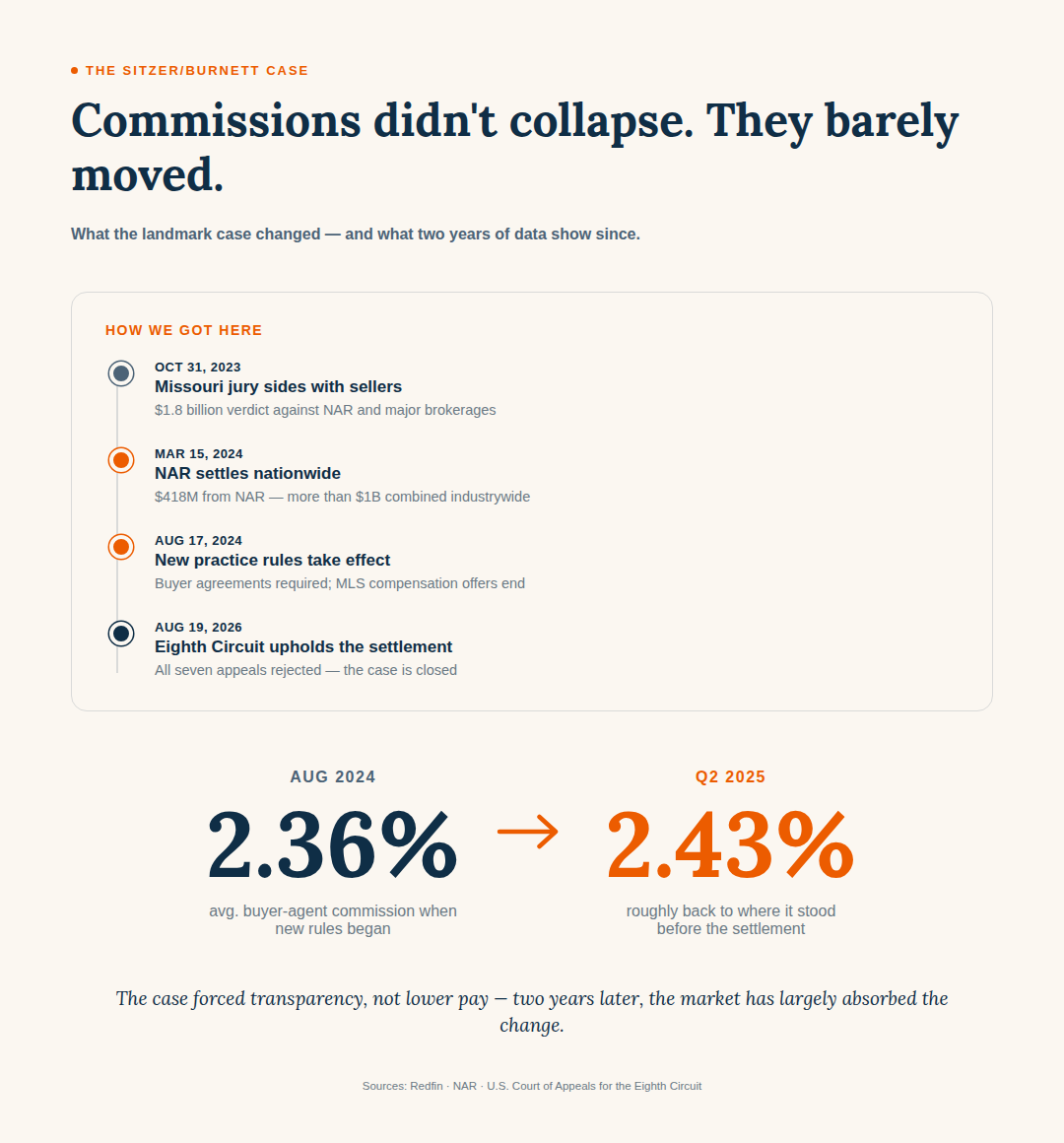
On October 31, 2023, a Missouri jury sided unanimously with the sellers, finding that NAR and the named brokerages had conspired to keep commission rates elevated. The jury awarded $1.8 billion in compensatory damages, an amount that could have been tripled to as much as $5.4 billion under federal antitrust law’s treble-damages provision.
The Settlement and the Practice Changes
Rather than proceed through the appeals process on the verdict itself, NAR reached a nationwide settlement announced on March 15, 2024, agreeing to pay $418 million over four years and to overhaul the rules at the center of the case. Other named defendants settled separately: Keller Williams agreed to pay $70 million, Compass agreed to pay $57.5 million, and Anywhere and RE/MAX reached their own settlements as well, bringing the combined total across the industry to more than $1 billion.
The practice changes took effect on August 17, 2024, and fundamentally altered how commissions are negotiated and disclosed:
The Cooperative Compensation Rule was eliminated, meaning listing agents are no longer required to offer buyer’s agent compensation through the MLS in order to list a property.
MLS platforms can no longer display offers of buyer-agent compensation, removing that information from the listing itself.
Sellers must explicitly authorize any compensation offered to a buyer’s agent, rather than having it built into the listing process by default.
Buyer’s agents must sign a written agreement with a buyer, disclosing and agreeing on compensation, before showing that buyer a home.
What Has Happened Since
Two years in, the data on commission rates has surprised a lot of people. According to Redfin, the average buyer’s agent commission was 2.36% when the new rules took effect in August 2024. By the second quarter of 2025, it had risen to 2.43%, roughly back to where it stood before the settlement. RealTrends Consulting reported a similar pattern, with commissions climbing from 2.65% in September 2024 to 2.71% by early August 2025. The increase hasn’t been uniform: in Austin, agents have reportedly pushed rates up toward 3%, while in Minneapolis, some buyers have negotiated commissions down to 2.5%. In short, commissions didn’t collapse the way many predicted. They largely held steady, and in a number of markets, they’ve ticked up.
The legal and regulatory pressure hasn’t let up either. In December 2025, the Department of Justice filed a statement of interest in a separate commission lawsuit, Davis v. Howard Hanna Holdings, arguing that NAR and MLS rules should be treated as “per se” unlawful under antitrust law rather than evaluated under the more lenient “rule of reason” standard. That’s a meaningful shift: it signals the DOJ no longer accepts “we were just following NAR’s rules” as a defense for individual brokerages, and that firms may bear direct antitrust exposure for their own commission practices going forward.
Individual brokerages have also come under new scrutiny. In 2026, Compass faced a class-action lawsuit over a $475 transaction fee charged to Florida homebuyers, and the Consumer Federation of America petitioned the FTC and DOJ to investigate Compass’s MLS partnerships and listing practices. The House Antitrust Subcommittee has since sought answers directly from Compass and MRED, the Chicago-area MLS, about those arrangements.
Then, on August 19, 2026, the Eighth Circuit closed out the appeals. A three-judge panel rejected every argument raised by the seven objectors, including a claim from law professor Tanya Monestier that the settlement’s damages were too small to meaningfully help consumers. The court found evidence of “ongoing, continuous injury” to the class and concluded that the practice changes themselves, not just the money, addressed the harm the lawsuit identified. NAR called the ruling a validation of its commitment to “fair, transparent, and pro-consumer real estate markets.” Hagens Berman, the plaintiffs’ lead firm, called it a victory for consumers.
The Takeaway
The Sitzer/Burnett case didn’t eliminate real estate commissions, and it didn’t force them down the way some predicted when the verdict first came in. What it did was require transparency: buyers now sign an agreement spelling out what they’re paying their agent and why, before that agent ever shows them a home, and sellers now have to affirmatively decide whether to offer buyer-agent compensation rather than having it happen automatically. Two years of data suggest the market has largely absorbed those changes without a meaningful drop in what agents are paid. With the Eighth Circuit’s ruling now final and the DOJ signaling it isn’t done looking at how individual brokerages set their rates, the more interesting fight may be just getting started: not over whether commissions should be disclosed, but over whether the rates themselves, and the business practices around them, hold up to further scrutiny.
