
New Jersey Mansion Tax: One Year Later
If you are buying or selling a home for $1 million or more in New Jersey, a law that quietly took effect in July 2025 is already affecting your bottom line, whether you knew it existed or not. New Jersey’s so-called “mansion tax,” officially the graduated fee on the Realty Transfer Fee, changed twice last year: the rate became graduated instead of flat (1 percent on the portion from $1 million to $2 million, climbing to 3.5 percent above $3.5 million), and for the first time, the obligation to pay it moved from the buyer to the seller. In Bergen County, where towns like Alpine, Saddle River, Tenafly, and Franklin Lakes routinely clear that $1 million threshold, this is not a niche detail. I have had to explain this law, from scratch, to sellers who had no idea it existed until I brought it up.
What Actually Changed, and Who Pays It Now?
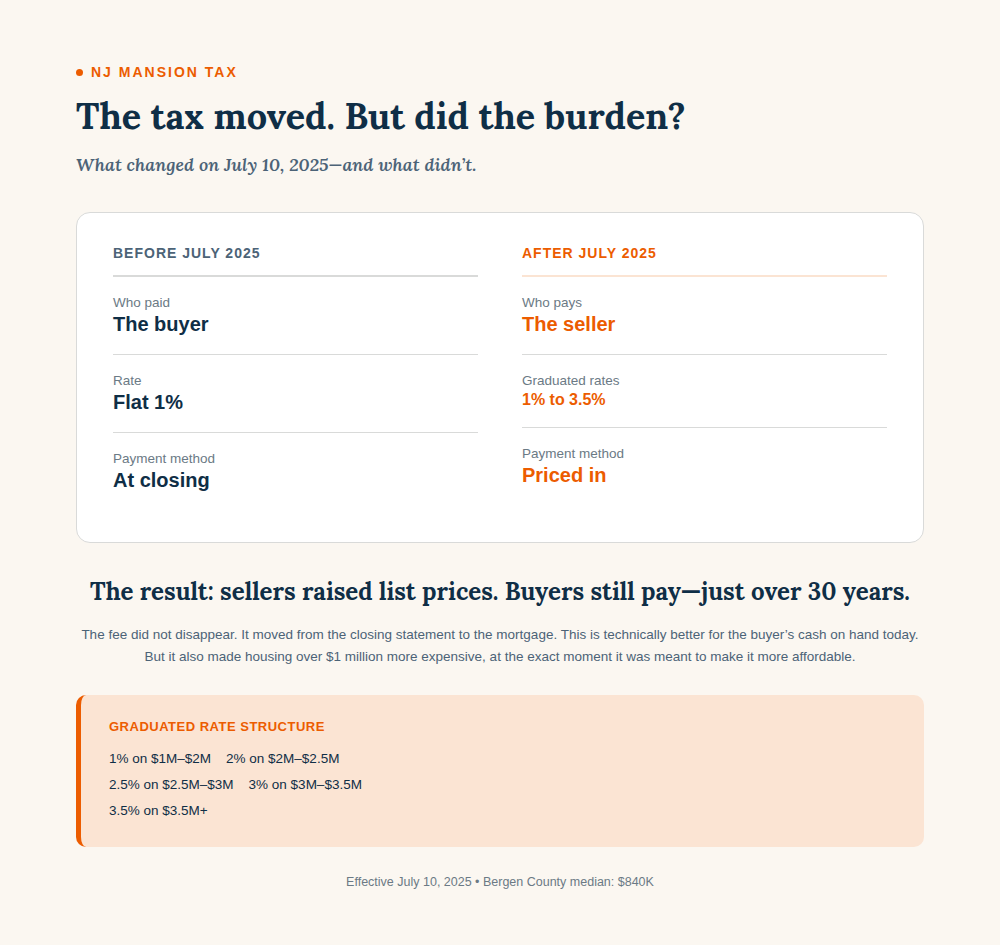
The final bill, S4666/A5804, was signed by Governor Murphy on June 30, 2025, and took effect ten days later, on July 10, 2025. Before that, the buyer paid this fee at closing, and it was a flat 1 percent above $1 million. Now, the seller pays it, on a graduated scale: 1 percent on the portion from $1 million to $2 million, 2 percent from $2 million to $2.5 million, 2.5 percent from $2.5 million to $3 million, 3 percent from $3 million to $3.5 million, and 3.5 percent on anything above $3.5 million.
This was not the original plan. Governor Murphy’s February 2025 budget proposal wanted to raise the rate even higher (2 percent from $1 million to $2 million, 3 percent above $2 million) while keeping it buyer-paid. NJ Realtors pushed back for four months, arguing that “mansion” no longer described reality (86 New Jersey towns had median listing prices above $1 million by that March) and that a buyer-paid hike would land on ordinary families buying ordinary homes in an expensive county, not on anyone buying an actual mansion. The seller-paid, graduated version that finally passed was the compromise.
What Was This Actually Supposed to Do?
Two things, really. First, raise money. Treasury projected the change would bring in over $300 million more than the old structure, revenue the state needed to close a deficit, fund the Stay NJ property tax relief program, and cushion against anticipated federal Medicaid cuts. Second, protect buyers. By moving the obligation to the seller and narrowing who actually gets hit, lawmakers were trying to keep this cost off the closing statement of a family buying a $1.2 million home.
So Has It Actually Helped Buyers? Here’s What I’m Seeing
I can tell you what the state’s revenue numbers look like (they are coming in strong, ahead of projections even), but what I actually want to talk about is what happens in my own listing appointments, because that is where this law shows its real effect.
Almost every seller I have worked with since July 2025 was unaware this law existed until I told them. That is not a criticism of them. It passed quickly and quietly, and nobody reads Realty Transfer Fee legislation for fun. But once I explain it, the conversation almost immediately turns to navigating the list price to accommodate it.
So did this actually lower the burden on the buyer? Not from what I am seeing. The fee did not disappear, it just moved. Instead of the buyer paying it out of pocket at closing, the seller builds it into the sale price, and the buyer ends up financing it into their mortgage instead. Don’t get me wrong, that is technically better for a buyer’s cash on hand. Needing less money at the closing table is a real benefit, especially for buyers who are already stretching to afford a home in this price range. But I would argue it also made housing over $1 million more expensive, even as it made it more affordable, at the same time. The buyer is not writing a separate check for this fee anymore. They are paying it, plus interest, for the next thirty years, baked into a higher purchase price.
Meanwhile, the buyers I am working with are consistently caught off guard by how much prices in New Jersey keep climbing, full stop, this law aside. Did this contribute to $1 million-plus homes staying high, or climbing higher? I do not know for certain. But from what I am seeing in my own transactions, maybe.
The Takeaway
The state appears to be getting what it wanted out of this law: more revenue, collected reliably, from sellers instead of buyers. Whether buyers are actually better off is a much murkier question, and in my experience, the answer leans no. Sellers are not absorbing this cost. They are pricing it in, which means buyers are still paying it, just differently, and over a much longer period of time. If you are selling above $1 million in Bergen County, know that this conversation is coming, and have it with your buyer’s expectations in mind, not just your own net proceeds. If you are buying above $1 million, know that the price you are agreeing to may already have this fee quietly built into it. Either way, it is better to understand this law before you are sitting at the closing table than to be surprised by it there.
