
A Hidden Agenda for Office Exclusives: Dual Agency
Dual agency happens when a single real estate agent, or a single brokerage, represents both the buyer and the seller in the same transaction. It’s been part of real estate law for decades as a narrow exception to how representation normally works. What’s changed recently is how often some firms are steering deals into it on purpose, rather than treating it as the rare situation it was designed to be.
What Is Dual Agency?
In a typical sale, the buyer has their own agent and the seller has their own agent, and each agent owes full loyalty and advocacy to their own client. Dual agency collapses that into one agent, or one brokerage, representing both sides at once. In New Jersey, this is only allowed with written, informed consent from both parties, and the state’s Real Estate Consumer Protection Enhancement Act (effective August 1, 2024) spells out exactly what a “disclosed dual agent” can and cannot do: they must avoid taking any action adverse to either party, disclose conflicts as they arise, and keep both parties’ confidential information protected, even after closing.
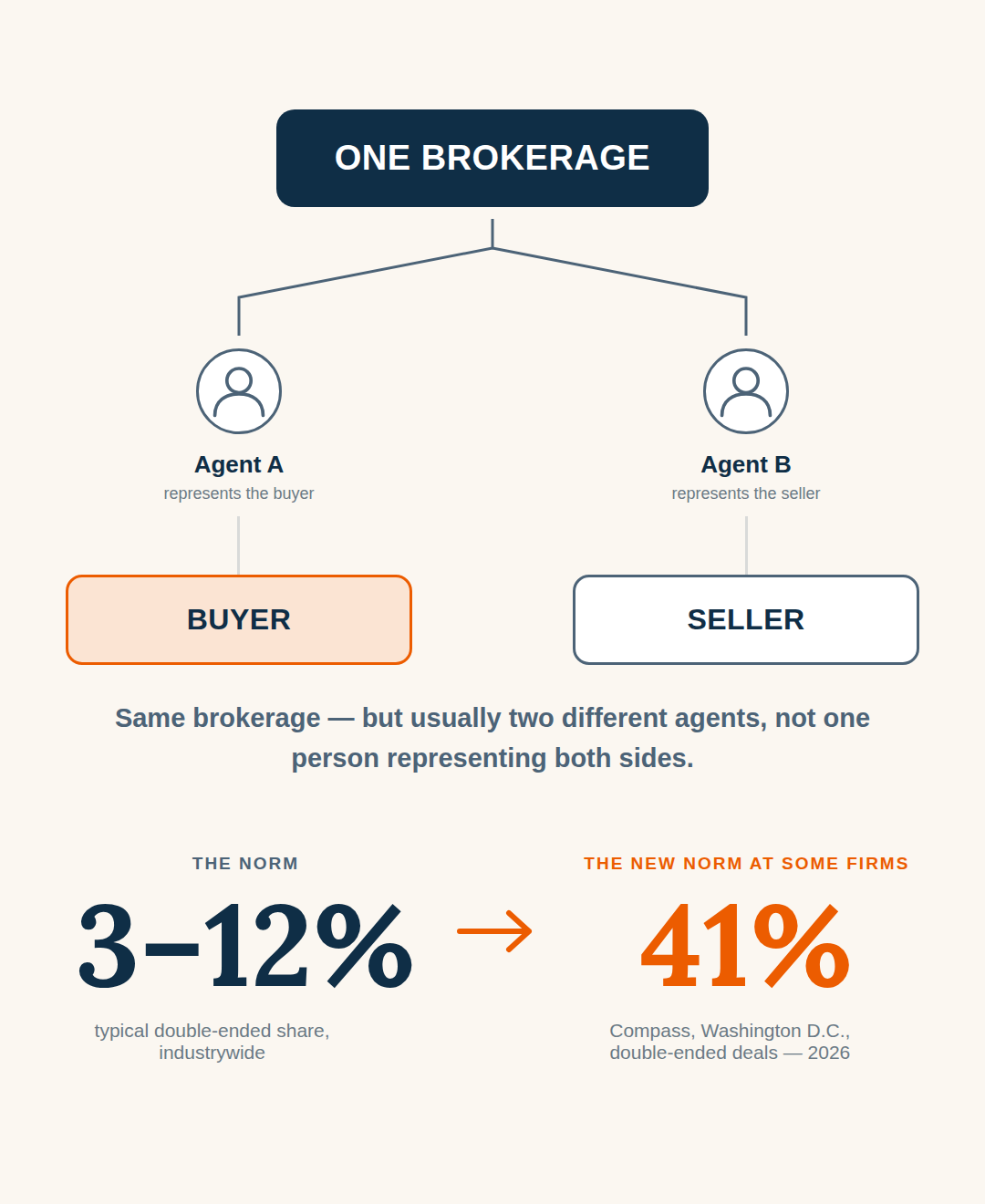
That same law also created a related option called designated agency, where a brokerage assigns one licensee to the seller and a different licensee to the buyer, while the brokerage itself still technically represents both sides. It’s marketed as a middle ground, but the underlying conflict, one company with a financial interest in both halves of the deal, doesn’t fully go away.
Why It Matters
Every agent operates under a fiduciary duty: full loyalty, full disclosure, and negotiating everything in their client’s best interest. Dual agency legally caps that duty for both parties at the same time, since the agent can’t fully advocate for one side without working against the other. Buyers and sellers need to understand this isn’t a technicality. It changes what their agent is legally allowed to tell them, negotiate for them, and push for on their behalf.
Advantages
Streamlined communication: One agent handling both sides can mean fewer scheduling delays and faster back-and-forth on paperwork, since there’s no coordinating between two separate offices.
Potentially faster closings: With fewer parties involved in negotiating logistics, some dual agency deals move through the process more quickly.
Lower perceived cost: Because only one brokerage is being compensated, dual agency is sometimes marketed to sellers as a way to reduce the total commission paid on the sale.
Disadvantages
Inherent conflict of interest: The agent’s duty to advocate fully for one party is legally limited by the exact same duty owed to the other. Neither side gets the full, unrestrained representation they’d get from an independent agent.
Reduced negotiating leverage: Buyers and sellers each lose an advocate who is solely focused on getting them the best possible terms, which can affect price, contingencies, and repair negotiations.
The “double-ending” incentive: When one brokerage captures both sides of the commission, there’s a financial incentive to keep the deal in-house rather than actively marketing it to outside agents and buyers who might pay more or negotiate harder.
My Take
I’ve represented both sides of a transaction myself, when the circumstances genuinely called for it. And I often hated it. It’s not a position I look for, and it’s not something I’ve ever wanted to build a business around. I’d rather fully represent one side of the table than half-represent two.
How Some Firms Made It a Go-To Strategy
Dual agency was written into real estate law as an occasional exception, something that happens when, say, a buyer falls in love with a home listed by their own agent’s brokerage. But a growing body of reporting suggests some of the largest brokerages have built it into how they do business.
Compass, now the largest brokerage in the country by sales volume, is the clearest example. An April 2026 analysis by the Consumer Policy Center found that in Washington, D.C., 41% of Compass’s deals were “double-ended,” meaning the brokerage represented both sides, up from a historical range of 3–12% industrywide. The same report found Compass’s off-market “Private Exclusives” listings were double-ended at 72% higher rates than listings marketed openly on the MLS. Notably, in the large majority of those double-ended D.C. deals, it wasn’t even one agent representing both sides. It was two different agents within the same brokerage, which still keeps the entire commission in-house.
Real estate analyst Jonathan Miller has pointed to comments from Compass’s own CEO on an earnings call, asking rhetorically what seller wouldn’t want their listing agent to also bring the buyer, as evidence that keeping deals in-house is a deliberate commission strategy, not simply a service to the client. Consumer advocates have gone further, and some have called designated agency arrangements a workaround that lets a brokerage double-end a deal while still technically assigning “separate” agents to each side.
For buyers and sellers, the practical takeaway is the same either way: when your agent’s brokerage benefits financially from keeping a deal entirely in-house, it’s worth asking directly whether that’s shaping how your home is being marketed, or whether you’re being shown every option available to you.
The Takeaway
Dual agency isn’t illegal, and in the right circumstances it isn’t even necessarily a bad outcome for a motivated buyer or seller. But it only works fairly when both parties understand exactly what they’re consenting to, and when it’s the exception rather than the default. As more of the industry moves toward keeping transactions in-house, buyers and sellers should feel comfortable asking their agent directly how a deal is being represented, and on whose behalf.
