
Who Does a 50-year Mortgage Actually Help?
On November 8, 2025, President Trump posted on Truth Social floating a 50-year mortgage as a fix for housing affordability, comparing it to FDR’s introduction of the 30-year mortgage nearly a century ago. Within hours, FHFA Director Bill Pulte confirmed the administration was “indeed working on” it, calling it “a complete game changer.” The idea drew heavy coverage and even heavier pushback through mid-November. It’s still just a proposal, not a product you can apply for, but it’s worth understanding what it would actually do to a monthly payment, and to the thing most homeowners rely on to build wealth: equity.
What’s Being Proposed
The pitch is simple on its face: stretch mortgage debt over 50 years instead of 30, and the monthly payment drops because the loan is repaid more slowly. Supporters frame it as a way to get more buyers into homes they otherwise couldn’t afford, in the same spirit as the 30-year mortgage itself, which was a New Deal-era innovation designed to make homeownership accessible after the shorter, balloon-payment loans of the 1920s pushed many borrowers into default.
There’s a real legal obstacle standing between the idea and the market, though. Under the Dodd-Frank Act, a “Qualified Mortgage,” the category of loan that comes with the strongest consumer protections and is the easiest for lenders to sell to Fannie Mae and Freddie Mac, is currently capped at a 30-year term. Actually offering 50-year loans at scale would require either a regulatory rule change or new legislation. As of mid-November 2025, neither had happened, and the proposal remained a policy conversation rather than a lending option.
The Math: Lower Payment, Slower Equity
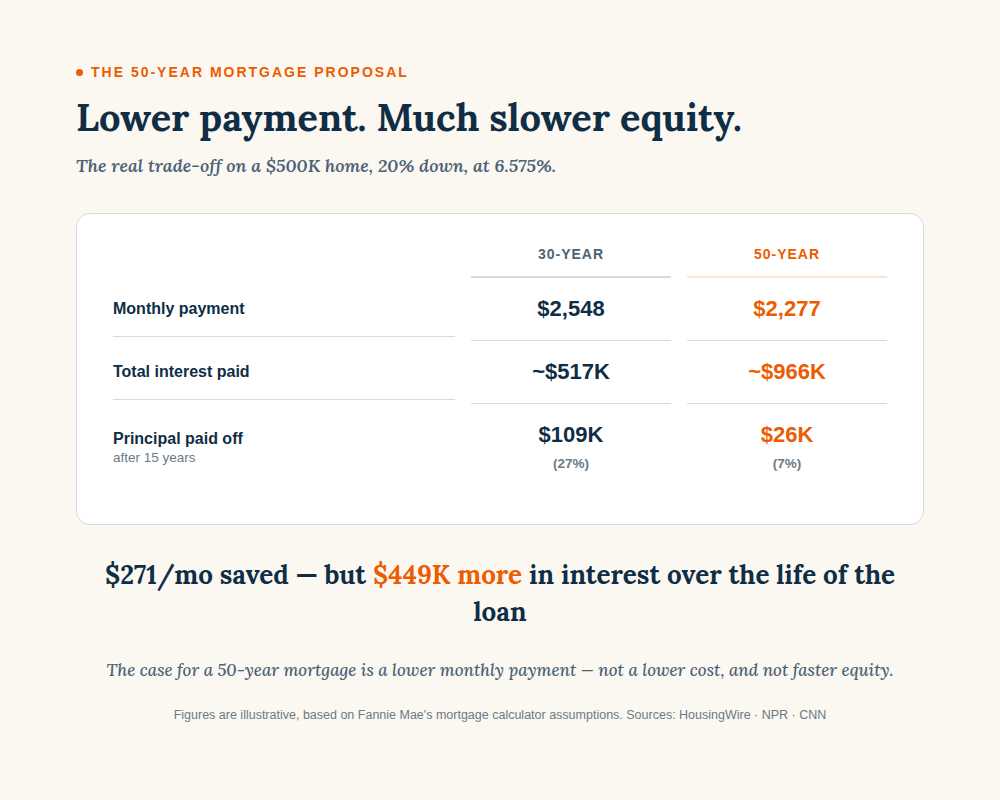
Here’s where it gets concrete. Using Fannie Mae’s own mortgage calculator at a rate of roughly 6.575%, a $500,000 home purchased with 20% down works out to about:
30-year term: $2,548/month
50-year term: $2,277/month
That’s a real difference, about $271 less per month, which matters in a state like New Jersey where property taxes already stretch monthly housing budgets. But the trade-off is significant. Stretching the same loan amount over 20 additional years means a much larger share of every payment goes to interest rather than principal, especially in the early years. Over the life of the loan, a 50-year borrower would pay dramatically more in total interest than a 30-year borrower, and would take decades longer to build meaningful equity. A buyer who might have owned a third of their home outright after 15 years on a 30-year mortgage could still owe the vast majority of the balance at that same point on a 50-year term.
What Critics Are Saying
The response from housing economists has been skeptical. Logan Mohtashami, lead analyst at HousingWire, has argued that stretching loan terms doesn’t address the actual cause of the affordability problem, which is that home prices have outpaced incomes. Instead, he and others contend, it simply subsidizes demand: more buyers can technically qualify for a payment, which can put more upward pressure on prices rather than making homes more affordable in real terms. There’s also a wealth-building concern. Homeownership has historically been one of the most reliable ways American households build equity over time. A loan structure that keeps borrowers in a high-interest, low-equity position for decades longer works against that, particularly for first-time buyers who are already stretching to get in the door.
Who Does a Longer Loan Term Actually Serve?
Stretching a mortgage from 30 years to 50 years does lower the monthly payment, but it also keeps a borrower paying interest to a lender for twenty additional years. A lender collects interest for as long as the loan is outstanding, so a longer term is not simply a favor to the borrower. It is also a longer, more profitable relationship for whoever holds the loan. That does not make the idea dishonest, but it is worth asking who benefits most from the arrangement before assuming the borrower does.
This structure is familiar to anyone who has sat across a desk at a car dealership and been offered a lower monthly payment by extending the loan to 72 or 84 months instead of 60. The payment looks more manageable, but the total cost climbs, and the buyer often ends up financing the car for longer than they actually want to keep it. A 50-year mortgage follows the same logic on a much larger scale, and over a much longer stretch of a homeowner’s life.
There are other ways to address affordability that do not involve extending debt for half a century, including down payment assistance programs and buying down the interest rate at closing. Neither of those gets the same attention as a headline-grabbing 50-year term, but both address cost without pushing equity decades further out of reach.
The Takeaway
A 50-year mortgage is not a plan to make homeownership more affordable. It is a plan to make a specific home more affordable to finance, by shifting cost into the future and equity further out of reach. In a high-property-tax market like ours, that trade-off deserves real scrutiny before anyone treats a lower payment as the same thing as an affordable home. My advice to clients has not changed: adjust the search to fit the budget, rather than adjusting the math to fit the search. A lower payment that comes from a longer loan term is not the same as a home that was affordable to begin with.
So, who does a 50-year mortgage actually help? Lenders.
Sources: HousingWire, NPR, CNN, Forbes
