
‘Tis the Season for Office Exclusives
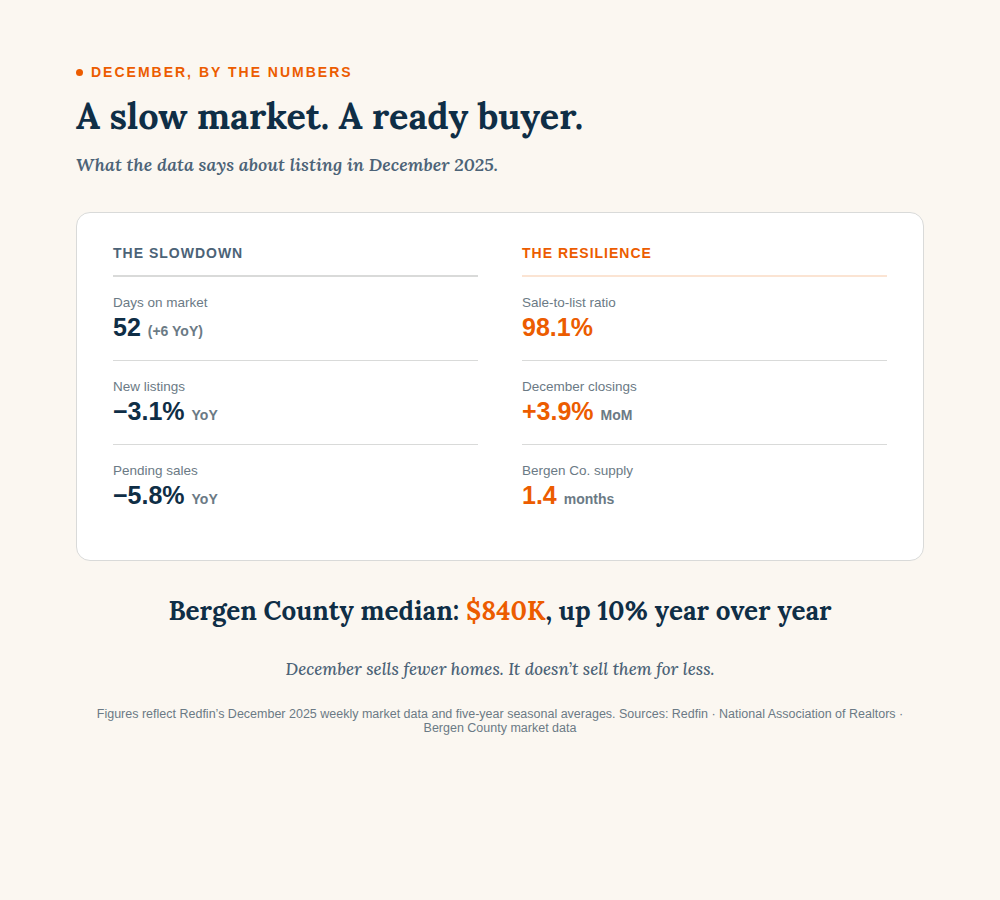
December has a reputation, and the data mostly backs it up. Redfin’s mid-December report this year put the median home on the market for 52 days, up six days from a year earlier. New listings fell 3.1 percent year over year, the biggest monthly decline of 2025, and pending sales dropped 5.8 percent, the sharpest pullback in eleven months. Zoomed out over five years, Redfin’s seasonal averages show December consistently running as the slowest month to sell (50.3 days on market, against 30 days in May), with only 21.8 percent of homes selling above list, compared to 37.9 percent in May. Winter prices as a whole run about 3.9 percent below the yearly average, and January is typically the low point at negative 7 percent.
By nearly every public measure, December is the worst month of the year to put a house on the open market.
So Why Would Anyone List in December?
Because the same data that makes December look weak also makes a case for it, if you know where to look. The sale-to-list ratio in mid-December sat at 98.1 percent, only about two points off the entire year’s peak in June. Sellers who do list in December are not giving nearly as much away as the “slow month” headline suggests. Nationally, closings actually rose 3.9 percent from November to December, and the buyer pool shifted slightly toward first-time, owner-occupant buyers (roughly 31.8 percent of transactions) and away from cash and investor purchases (down to about 21.7 percent). Locally, Bergen County closed out 2025 with single-family inventory at just 1.4 months of supply and a median price near $840,000, up roughly 10 percent year over year. Whatever competition exists in December, it is not coming from an oversupply of listings.
None of that shows up as a clean, citable statistic, but every agent who has worked through a December season will tell you the same thing in different words: the people still out looking for a house between Thanksgiving and New Year’s are not casually browsing. They are looking because they need to.
The Case for Office Exclusives
Here is where I part ways with the general advice.
Sellers hate disruption during the holidays. Nobody wants their to be constantly cleaning their home for showings the week before a family gathering, and fewer still want to keep it that way for six or eight weeks while the market slows around them. At the same time, most buyers are not in a position to seriously consider the biggest purchase of their lives in December. They are budgeting for the holidays, not a down payment, and the mental bandwidth for a house hunt is simply not there for most people until January.
Put those two things together, and a full public listing in December is often working against itself. Sellers are absorbing the disruption of an open market, and the open market is not delivering the volume of serious buyers that would justify it. The data above bears this out: fewer new listings, fewer pending sales, longer days on market.
An office exclusive changes that equation. Instead of exposing a home to every casual search on the portals during the slowest month of the year, it stays within the brokerage networks, and reaches the buyers who are already working with an agent, already pre-approved, and already looking with intent, which is exactly the kind of buyer this season tends to produce anyway. The seller avoids the disruption of a full public rollout during the holidays. The showings that do happen are with people who are actually ready to act, not holiday window-shoppers. And when the listing is ready for a wider audience, it can move to the open market in January with momentum instead of sitting stale over the ones that never left.
I have written before about the risks of office exclusives, and I stand by that caution for most of the year. Keeping a deal off-market can mean less market exposure and less pressure to find the best possible price, and that trade-off deserves real scrutiny. But December is a genuine exception. When the open market itself is producing fewer showings, slower sales, and a smaller buyer pool, the exposure a public listing would normally provide is not worth as much to begin with. In that narrow window, a controlled, exclusive approach can serve a seller better than throwing the door open to a market that, by its own numbers, is not paying much attention.
The Takeaway
The public data on December is not wrong: it is a slow month to sell by nearly every measure. But slow does not mean bad, if you list the right way. For sellers who want to avoid holiday disruption and still reach the buyers who are genuinely ready to move, an office exclusive can turn December’s quiet market into an advantage instead of a liability.
‘Tis the season, in other words, not for the biggest audience, but for the right one.
Sources: Redfin (December 2025 weekly market data and five-year seasonal averages), National Association of Realtors, Bergen County market data
